Austin-Broos D. A Different Inequality: The Politics of Debate about Remote Aboriginal Australia. Allen & Unwin; 2011.

An exploration of why both the right and left of politics have so failed remote Aboriginal Australians, and why until policymakers and researchers take into account both cultural difference and inequality, we will not come anywhere near closing the gap.
Stanner WEH. The Dreaming and Other Essays. Black Inc; 2011.

W.E.H. Stanner’s words changed Australia. Without condescension and without sentimentality, in essays such as ‘The Dreaming’ Stanner conveyed the richness and uniqueness of Aboriginal culture. In his Boyer Lectures he exposed a ‘cult of forgetfulness practised on a national scale,’ regarding the fate of the Aborigines, for which he coined the phrase ‘the great Australian silence’.
And in his essay ‘Durmugam’ he provided an unforgettable portrait of a warrior’s attempt to hold back cultural change. ‘He was such a man,’ Stanner wrote. ‘I thought I would like to make the reading world see and feel him as I did.’
The pieces collected here span the career of W.E.H. Stanner as well as the history of Australian race relations. They reveal the extraordinary scholarship, humanity and vision of one of Australia’s finest essayists.
Saethre EJ. Illness Is a Weapon. Indigenous Identity and Enduring Afflictions. Vanderbilt University Press; 2013.
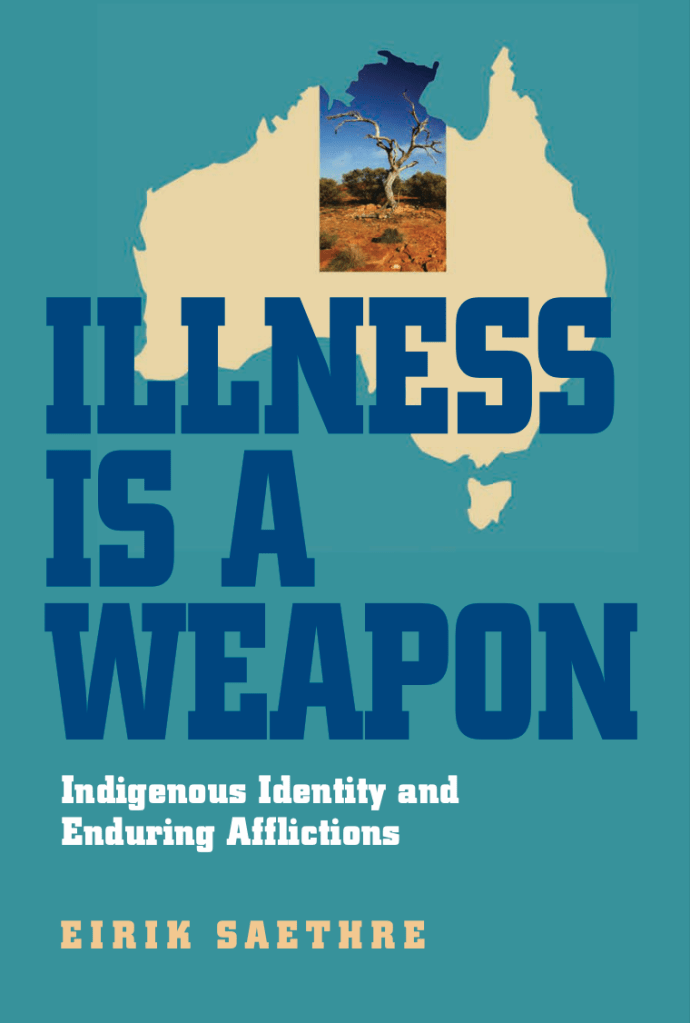
Illness Is a Weapon presents an engaging portrayal of the everyday experience of disease in a remote Australian Aboriginal community. While chronic Aboriginal ill health has become an important national issue in Australia, Saethre breaks new ground by locating sickness within the daily lives of Indigenous people.
Drawing on more than a decade of ethnographic research in the Northern Territory, Saethre explores the factors structuring ill health, the tactics individuals use to negotiate these realities, and the ways in which disease and medical narratives are employed to construct, manage, and challenge social relations. Reframing current debates, this book argues that disease and suffering have become powerful expressions of Indigenous identity.
Through dialogues and interactions, Aboriginal and non-Aboriginal people engage in a reciprocal discussion about the past, present, and future of indigeneity. Rarely is disease and suffering understood as a form of protest, and in Illness Is a Weapon, Saethre confronts the stark reality of the current contest between all parties in this struggle. As Saethre explains, “”Cursing at nurses, refusing to take medication, and accepting acute illness as unremarkable is simultaneously an act of defiance and a rejection of vulnerability.
Rowse T. White Flour, White Power: From Rations to Citizenship in Central Australia. Cambridge University Press; 1998. doi:10.1017/CBO9780511518287

The colonial practice of rationing goods to Aboriginal people has been neglected in the study of Australian frontiers. This book argues that much of the colonial experience in Central Australia can be understood by seeing rationing as a fundamental, though flexible, instrument of colonial government. Rationing was the material basis for a variety of colonial ventures: scientific, evangelical, pastoral and the post-war program of ‘assimilation’. Combining history and anthropology in a cultural study of rationing, this book develops a new narrative of the colonisation of Central Australia. Two arguments underpin this story: that the colonists were puzzled by the motives of the Indigenous recipients; and that they were highly inventive in the meanings and moral foundations they ascribed to the rationing relationship. This study goes to the heart of contemporary reflections on the nature of Indigenous ‘citizenship’.
Lea T. Beauracrats and Bleeding Hearts. New South Wales Publishing; 2008.

Bureaucrats and Bleeding Hearts takes you on an intimate journey into the lives of people armed with the task of ending Australian Aboriginal disadvantage in the frontier north of Australia. Taking a fresh look at longstanding issues, Lea examines the culture of bureaucracy, its need to create the look of action, how intelligent inhabitants uphold the apparatus of government even whilst they critique it, and how benevolent efforts to improve health have brought about unexpected co-dependencies and tragic failures. She paints a sympathetic yet discomforting portrait of those who, working on behalf of and for Aboriginal health, fiercely defend the ideas and principles that paradoxically reinstate the primary need for greater levels of government intervention.
Myers F. Pintupi Country, Pintupi Self. Sentiment, Place, and Politics among Western Desert Aborigines. University of California Press; 1986.
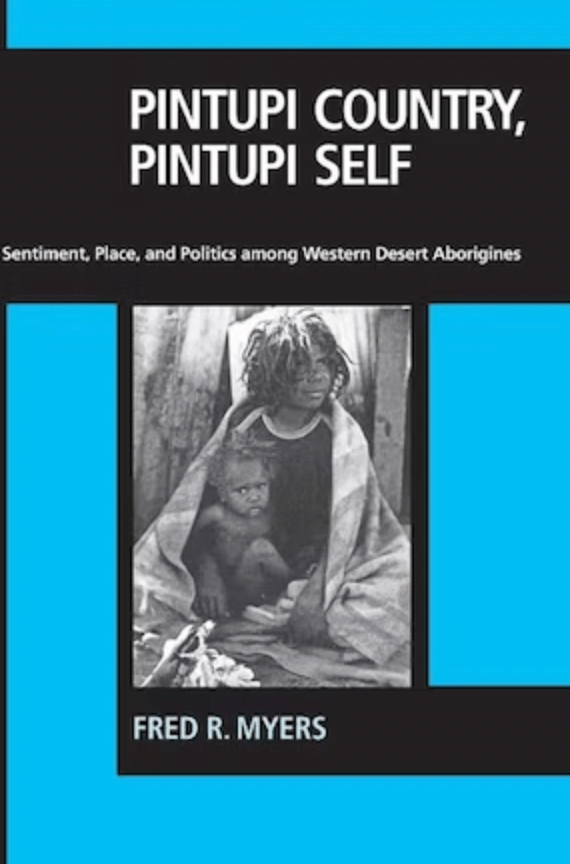
The Pintupi, a hunting-and-gathering people of Australia’s Western Desert, were among the last Aborigines to come into contact with white society. Despite their extended relocation in central Australian settlements, they have managed to preserve much of their traditional culture and social organization. This book presents a comprehensive ethnographic interpretation of the ways in which Pintupi politics, cosmology, kinship systems, nomadic patterns, and social values reinforce and sometimes contradict each other.
Folds R. Crossed Purposes. The Pintupi and Australia’s Indigenous Policy. University of NSW Press; 2001.

Why are we consistently confronted with the failure to achieve statistical equality in critically important areas such as health, housing, and education? Examining the relationship between the Pintupi people of Australia’s western deserts, Ralph Folds challenges many popular assumptions about the way indigenous groups like the Pintupi interact with western society.
Musharbash Y. Yuendumu Everyday. Contemporary Life in Remote Aboriginal Australia. Aboriginal Studies Press; 2009.

Focusing on an isolated community in central Australia, this highly-readable examination presents insights into the cultural underpinnings of indigenous daily life through evocative narratives revolving around five Warlpiri women. The seemingly contradictory realities of a distant hunter-gatherer past and current life in a first-world nation-state are addressed as this refreshing study answers questions about the specifics of camps, sleeping arrangements, public and private boundaries, and how indigenous people in praxis relate to each other. This analysis illuminates the personal, utilizing rich vignettes and narrative portraits to expand understandings of indigenous Australia.
Altman J, Hinkson M. Culture Crisis: Anthropology and Politics in Aboriginal Australia. UNSW Press; 2010.

In 2007 the Australian Government recognised that the health, safety and education of the nation’s remote Aboriginal citizens were in a state of crisis. Its response was what became known as the Northern Territory Intervention, which sparked a heated national debate about Indigenous disadvantage and autonomy. Moreover, it caused Australian anthropologists to question the contribution of their own discipline. Anthropology has always informed and provoked policy change, and has a tradition of confirming difference. So why did the government assume that Aboriginal culture must be interrupted, reshaped and developed, in order to be successful? In Culture Crisis, some of Australia’s leading anthropologists put the ‘Culture Wars’ under the microscope, dissecting the notion of difference and asking whether this is a useful way of looking at the problems remote Indigenous Australians face. An urgently needed dialogue, this book unflinchingly confronts the policies that have failed these communities and shows how the discipline of anthropology can still provide hope.
McCoy B. Holding Men. Kanyirinpa and the Health of Aboriginal Men. Aboriginal Studies Press; 2008.

This is an easily readable book that explores how Indigenous men understand their lives, their health and their culture.
Using conversations, stories and art, the author shows how Kimberley desert communities have a cultural value and relationship described as kanyirninpa or holding.
The author uses examples from Australian Rules football, petrol sniffing and imprisonment to reveal the possibilities for lasting improvements to men’s health based on kanyirninpa’s expression of deep and enduring cultural values and relationships.
While young Indigenous men’s lives remains vulnerable in a rapidly changing world, the author believes that an understanding of kanyirninpa (one of the key values that has sustained Aboriginal desert life for centuries) may provide the hope of change and better health for all. It also offers insights for all who wish to ‘grow up’ their young people.
Dussart F. “It Is Hard to Be Sick Now”: Diabetes and the Reconstruction of Indigenous Sociality. Anthropologica. 2010;52:77-87.
Dussart F. Diet, diabetes and relatedness in a central Australian Aboriginal settlement: some qualitative recommendations to facilitate the creation of culturally sensitive health promotion initiatives. Health Promotion Journal of Australia. 2009;20(3):202-206. doi:10.1071/he09202
 mparntwemedicalsociety.com